<?xml version="1.0"?>
<!DOCTYPE html PUBLIC
  "-//W3C//DTD XHTML 1.1 plus MathML 2.0//EN"
  "http://www.w3.org/TR/MathML2/dtd/xhtml-math11-f.dtd"
[
  <!ENTITY mathml "http://www.w3.org/1998/Math/MathML">
]>
<html xmlns="http://www.w3.org/1999/xhtml">
<head>
  <meta http-equiv="content-type" content="text/html; charset=ISO-8859-1"/>
  <title>Sandbox Model</title>
  <link rel="icon" href="sandbox-icon.png" type="image/png"/>
  <style type="text/css">
    div {text-align: center}
  </style>
</head>
<body> 
<h1>The Sandbox Model</h1>
<p>
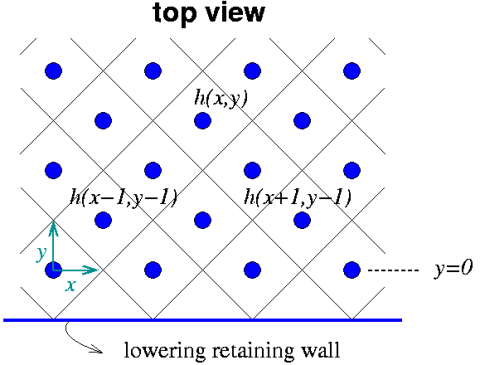
  We define a lattice model to simulate this system. A height
  variable, <math xmlns="&mathml;"><mi>h</mi></math>, is defined on
  a square lattice, <math xmlns="&mathml;"><mo>(</mo><mi>x</mi>
  <mo>,</mo><mi>y</mi><mo>)</mo></math>,
  tilted at 45&deg; meaning <math xmlns="&mathml;"><mi>x</mi></math>
  is an odd (even)
  integer when <math xmlns="&mathml;"><mi>y</mi></math> is an odd (even)
  integer.
</p>
<div>
<img src="lattice.png" alt="lattice structure" width="480" height="365"/>
</div>
<p>
  We then define the stability condition as
<math mode="display" xmlns="&mathml;">
  <mi>h</mi><mo>(</mo><mi>x</mi><mo>,</mo><mi>y</mi><mo>)</mo><mo>&le;</mo>
  <mo>min</mo><mo>[</mo><mi>h</mi><mo>(</mo><mi>x</mi><mo>-</mo><mn>1</mn>
  <mo>,</mo><mi>y</mi><mo>-</mo><mn>1</mn><mo>)</mo><mo>,</mo><mi>h</mi>
  <mo>(</mo><mi>x</mi><mo>+</mo><mn>1</mn><mo>,</mo><mi>y</mi><mo>-</mo>
  <mn>1</mn><mo>)</mo><mo>]</mo><mo>+</mo><msub><mi>s</mi><mi>c</mi></msub>
</math>
  and when the stability condition is violated, the toppling rule as
<math mode="display" xmlns="&mathml;">
  <mi>h</mi><mo>(</mo><mi>x</mi><mo>,</mo><mi>y</mi><mo>)</mo>
  <mo>&rarr;</mo><mo>min</mo><mo>[</mo><mi>h</mi><mo>(</mo><mi>x</mi>
  <mo>-</mo><mn>1</mn><mo>,</mo><mi>y</mi><mo>+</mo><mn>1</mn><mo>)</mo>
  <mo>,</mo><mi>h</mi><mo>(</mo><mi>x</mi><mo>+</mo><mn>1</mn><mo>,</mo>
  <mi>y</mi><mo>-</mo><mn>1</mn><mo>)</mo><mo>]</mo>
  <mo>+</mo><msub><mi>&eta;</mi><mi>i</mi></msub><mo>(</mo><mi>x</mi>
  <mo>,</mo><mi>y</mi><mo>)</mo>
</math>
  where <math xmlns="&mathml;"><mn>0</mn><mo>&le;</mo>
  <msub><mi>&eta;</mi><mi>i</mi></msub><mo>&le;</mo>
  <msub><mi>s</mi><mi>c</mi></msub></math>
  is a random number depends on the coordinate and avalanche index,
  <math xmlns="&mathml;"><mi>i</mi></math>.
</p>
<p>
  To simulate the slow lowering of the side wall, for each avalanche,
  indexed <math xmlns="&mathml;"><mi>i</mi></math>, we trigger
  it by taking one of the highest sites
  on the bottom row, <math xmlns="&mathml;"><mi>y</mi><mo>=</mo><mn>0
  </mn></math>, and reduce its height by a random
  amount, <math xmlns="&mathml;"><msub><mi>&eta;</mi><mi>i</mi>
  </msub></math>. We then repeatedly topple all the
  unstable sites until the whole system is stable. Since the stability
  of a site depends only on its two bottom neighbors, we choose to
  update the system row by row from the bottom.
</p>
<p>
  We call the sites topple in an avalanche the avalanche cluster and
  define the length and width of the avalanche to be the maximum
  difference in <math xmlns="&mathml;"><mi>y</mi></math> and
  <math xmlns="&mathml;"><mi>x</mi></math> coordinates of the toppling
  sites from the triggering point. The depth of an avalanche is
  defined as the maximum height change among the toppling sites while
  the mass is defined as the total height change of the whole
  avalanche cluster.
</p>
<hr/>
<address>
<a href="./">Back</a>|<a href="../">Home</a>
</address>
</body>
</html>
